 Indiiramma Garden
Check for Spider Mites When Leaves Turn Stippled
Fine pale speckling on a leaf deserves a closer look beneath it. Spider mites are one possible cause, but a damaged leaf and an ordinary spider's web are not enough to diagnose an infestation. Look for several kinds of evidence in the same area.
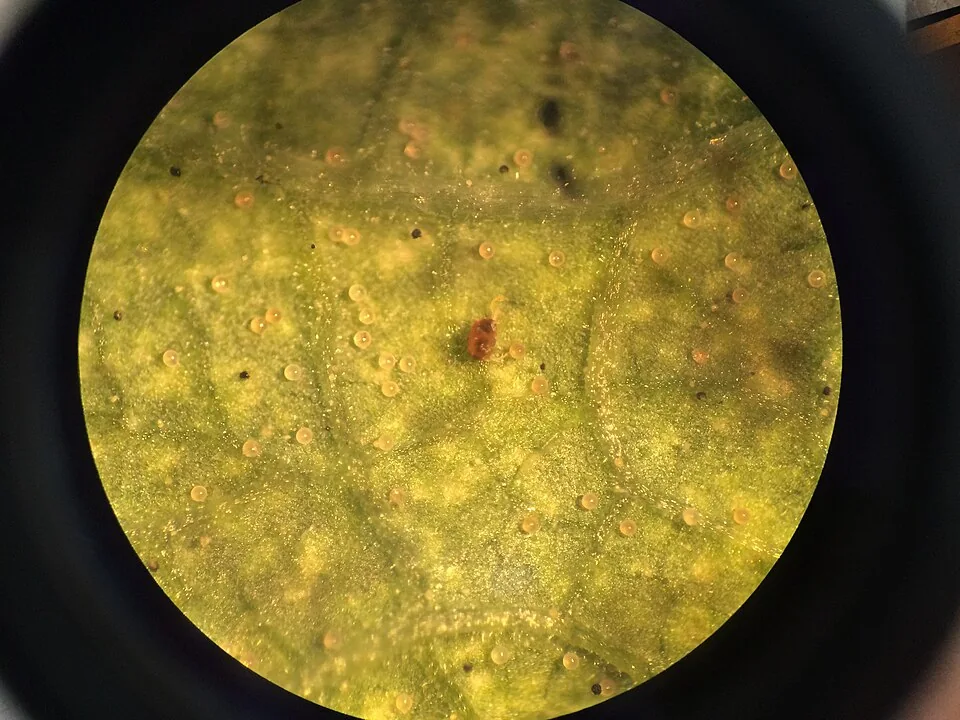
University of Minnesota Extension describes twospotted spider mites, Tetranychus urticae, as tiny arachnids that commonly feed beneath leaves. Feeding can cause stippling; heavier infestations may include fine webbing. A hand lens and inspection over white paper can help detect them. Minnesota spider mite guide
Inspect the underside of affected leaves
Choose both a damaged leaf and a nearby less-affected one. Compare undersides, veins, and the area where leaves meet shoots. Look with magnification rather than relying on a distant picture of the whole plant.
Hold clean white paper beneath a suspect leaf and tap gently. Examine anything that falls onto it. Moving dots justify closer identification; they do not automatically establish a pest species because other tiny organisms can be present too.
Photograph the leaf pattern, any webbing, and the organisms if possible. Note whether the plant was recently in hot, dry conditions or introduced from another growing area. That history supports an investigation without replacing direct evidence.
Keep suspected infestations from spreading unnoticed
Check nearby plants, especially the surfaces that face the affected container. Indoors, separate a confirmed infested plant where feasible, keeping its care needs in mind. Avoid carrying it through other foliage repeatedly while deciding what to do.
Review plant stress and water management. Correct unsuitable care, but do not flood a pot or mist the room as a promise of mite control. The root zone and the leaf pest are separate things to manage.
Where suitable for the plant, water washing can physically remove mites. Support foliage and choose a manageable place for runoff. Repeat observation is essential: examine the same parts and compare what is living there, rather than counting only the old pale marks.
Avoid treating every pest with the same bottle
Mites are not insects, and a product used for another pest is not automatically effective against them. If physical and cultural measures are insufficient, obtain guidance for the identified mite and plant. Any product must be labeled for the actual crop and indoor or outdoor setting.
Protect natural enemies in outdoor plantings rather than applying a broad treatment to every nearby container. Do not release purchased organisms without understanding whether the environment and problem suit them.
The cited guide concerns twospotted spider mites and includes landscape advice. Its field watering quantity is not a pot schedule. Stippling can overlap with other injury, and webbing should be examined in context; this article supplies no definitive photo diagnosis, pesticide dose, or guaranteed clearance interval. Continued live activity and the condition of new growth are more useful follow-up observations than expecting old marks to vanish.