 Indiiramma Garden
Start a Renter-Friendly Garden Without Permanent Changes
A small freestanding garden is easier to reconsider than a collection of fixed planters. Before buying anything, check what your agreement and building rules permit, where drainage can go, and how you will remove the garden later. “No drilling” does not automatically mean permitted, harmless, or easy to move.
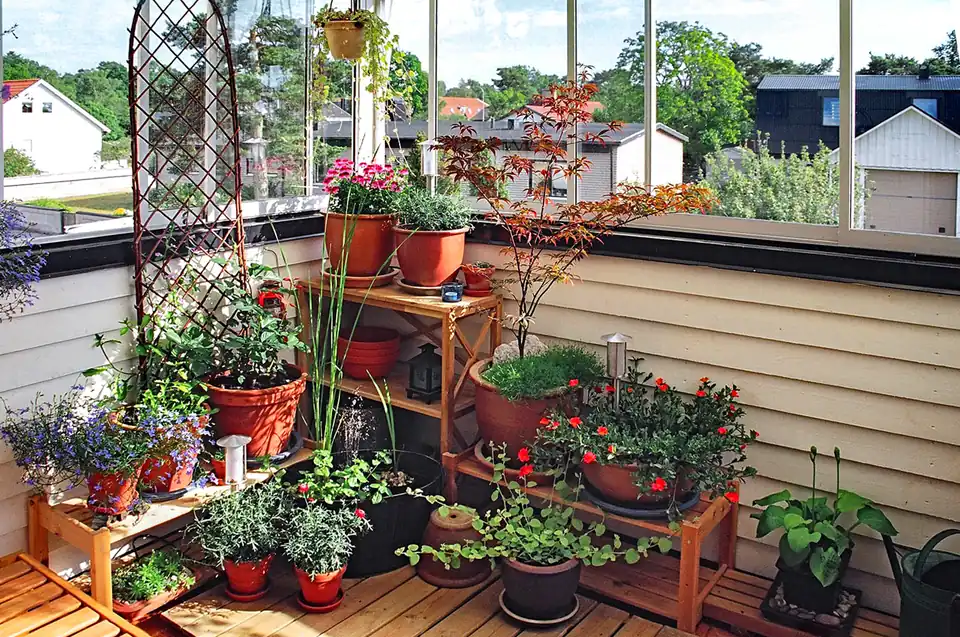
Check the actual constraints
Look for rules covering outdoor storage, access, attachments, hanging objects, water runoff, and alterations. Ask the relevant property contact when a proposed arrangement is unclear. Do not assume another renter's setup gives you the same permission.
Begin with a location that is already usable for ordinary freestanding items. Do not block a door or required route. Rail-mounted planters, adhesive hooks, privacy screens, and suspended pots need their own assessment; their being removable does not establish that they are suitable for the property.
Make the first version easy to revise
Choose a small number of containers and trial their empty positions. Check that you can reach the plants and the drainage area, open the door, and clean around the pots. A layout that works only when the plants are tiny is not a durable plan.
Colorado State University Extension identifies portable container gardens as an option for renters and people with limited space. It also notes that filled containers can be heavy. Plan the wet, planted container rather than judging portability from an empty pot in a shop.
Decide where the water will go
Consider the surface under every pot and the path of draining water. University of Maryland Extension warns that runoff can stain surfaces. A saucer may collect it, but requires attention and regular emptying where appropriate; it is not a universal fix for every container system.
Keep the area accessible for inspection. If you use a surface protector or stand, follow its instructions and the property's requirements. This article cannot guarantee that a material will prevent marks, moisture damage, or excessive loading.
Plan the move-out while the garden is small
Write down how you would remove plants, handle used growing medium, clean the space, and transport or dispose of the containers responsibly. Identify any item you could not move once filled. Solve that problem before planting, rather than leaving it for the final week of a tenancy.
As plants grow, check that foliage and supports remain within the intended area and that routine care still fits. Add more only when the first setup is working. A few healthy, reachable plants with a realistic removal plan make a more useful renter's garden than a larger arrangement you cannot maintain or take away.
Sources and scope
- Colorado State University Extension, Container Gardens.
- University of Maryland Extension, Growing Vegetables in Containers and Salad Tables.
Agreement checks and the removal checklist are editorial planning suggestions. No legal permission, structural capacity, surface compatibility, or damage-free result is certified.